Stage 3 Prostate Cancer Case Report Draws Attention to Ivermectin, Fenbendazole, CBD Oil, and Medical Documentation Concerns
A recently shared cancer patient testimonial has attracted significant attention across social media and cancer research communities. The case involves a 72-year-old man from New Jersey diagnosed with Stage 3 prostate cancer who reportedly experienced a substantial reduction in PSA (Prostate-Specific Antigen) levels over an eight-month period while following a protocol that included ivermectin, fenbendazole, CBD oil, and later radiation therapy.
Beyond the reported health outcomes, the story has generated discussion because of allegations regarding inaccuracies in medical documentation. According to the patient’s account, statements included in an oncology report allegedly described conversations that never occurred, raising questions about physician-patient communication and medical record accuracy.
While individual patient experiences can be compelling, researchers and healthcare professionals generally emphasize that testimonials should be viewed as personal accounts rather than definitive evidence of treatment effectiveness. Nevertheless, cases such as this continue to fuel interest in the emerging field of repurposed drugs and integrative cancer research.
Understanding Prostate Cancer and PSA Levels
Prostate cancer remains one of the most commonly diagnosed cancers among men worldwide. The disease develops in the prostate gland and can range from slow-growing forms that require minimal intervention to aggressive cancers requiring intensive treatment.
One of the primary tools used to monitor prostate cancer is the PSA test. PSA, or Prostate-Specific Antigen, is a protein produced by both healthy and cancerous prostate cells.
Doctors often use PSA levels to:
- Help detect prostate cancer
- Monitor treatment effectiveness
- Track disease progression
- Evaluate recurrence risk
- Assess long-term patient outcomes
Changes in PSA levels do not always tell the complete story, but they remain an important clinical marker for many prostate cancer patients.
The Reported Patient Case
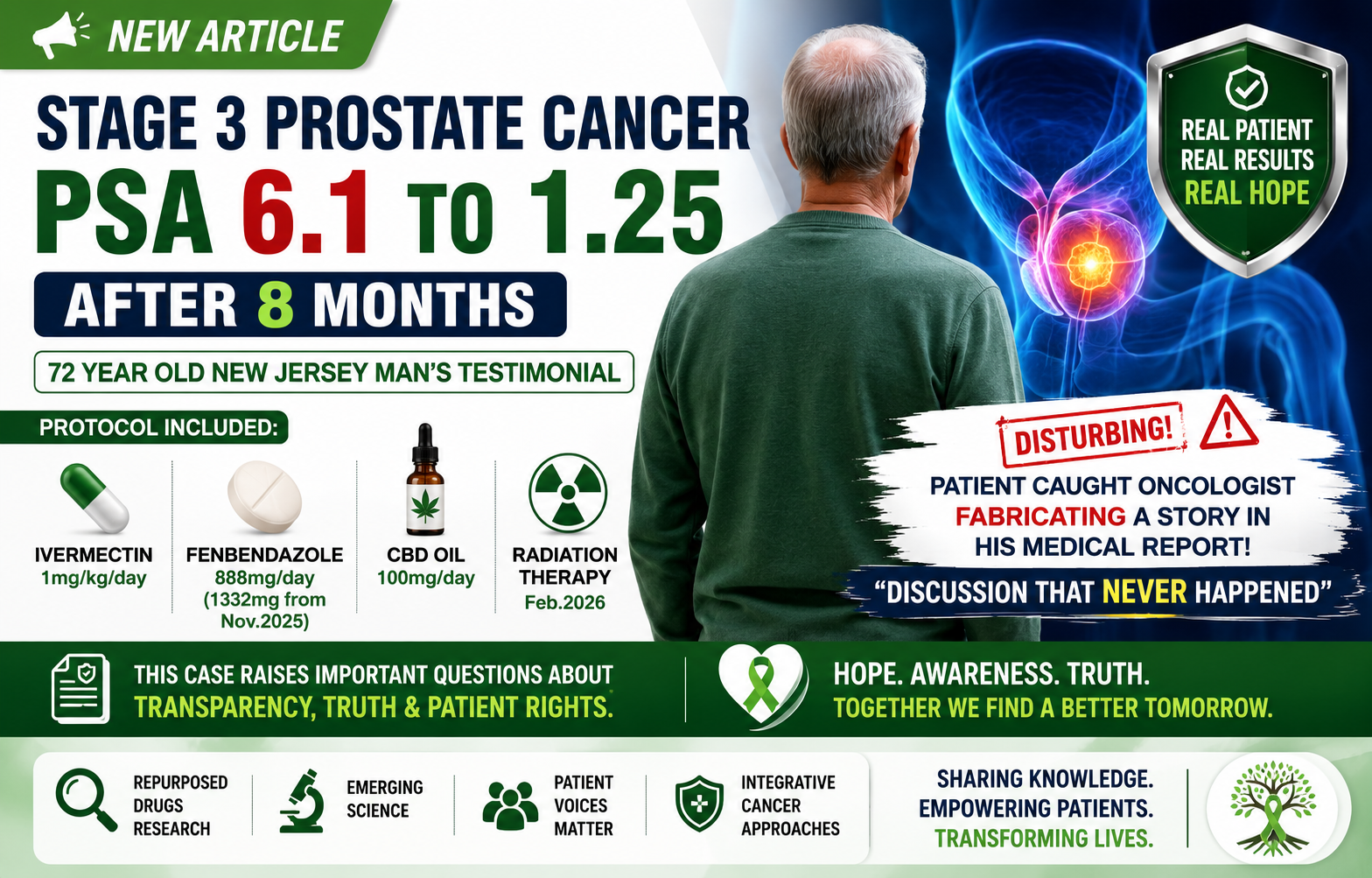
According to the publicly shared account, the patient was diagnosed with Stage 3 prostate cancer and began an alternative protocol in September 2025.
The reported regimen included:
- Ivermectin at 1 mg/kg daily
- Fenbendazole at 888 mg daily
- Increased fenbendazole dosage beginning November 2025
- CBD oil at 100 mg daily
- Radiation therapy initiated in February 2026
Supporters of the protocol highlighted that the patient’s PSA level reportedly declined from 6.1 to 1.25 after approximately eight months.
The reported reduction has been cited by advocates as a potentially encouraging outcome. However, determining which factors contributed to changes in PSA levels requires careful scientific analysis, especially when multiple interventions are used simultaneously.
Why This Case Has Attracted Attention
Several aspects of the story have contributed to widespread public interest.
Multiple Treatment Approaches
Unlike many individual case reports that focus on a single intervention, this patient reportedly utilized multiple therapies during the same period.
These included:
- Repurposed medications
- Nutritional support
- CBD oil
- Conventional radiation therapy
Because several interventions were involved, determining the contribution of any individual component becomes significantly more challenging.
Growing Interest in Repurposed Drugs
Over recent years, researchers have increasingly investigated whether existing medications could offer benefits beyond their original approved uses.
Ivermectin and fenbendazole have become particularly well-known among cancer patients seeking information about alternative approaches.
Medical Documentation Concerns
The story also includes allegations regarding statements documented within medical records, adding another layer of controversy to the discussion.
What Is Ivermectin?
Ivermectin is an antiparasitic medication used globally for decades.
Researchers have investigated ivermectin in laboratory settings for a variety of potential applications beyond parasite treatment.
Areas of scientific interest include:
- Cell signaling pathways
- Tumor metabolism
- Cellular growth mechanisms
- Immune system interactions
- Cancer cell survival processes
Although laboratory studies have generated interest, researchers continue to emphasize the need for larger human studies before conclusions can be drawn regarding cancer treatment effectiveness.
What Is Fenbendazole?
Fenbendazole is a veterinary antiparasitic medication commonly used in animals.
Interest in fenbendazole grew dramatically after a number of anecdotal cancer recovery stories appeared online.
Researchers have explored several biological mechanisms that may potentially influence cancer-related pathways, including:
- Microtubule disruption
- Cellular metabolism changes
- Oxidative stress pathways
- Tumor growth regulation
While these findings have attracted attention, scientists note that laboratory observations do not automatically establish clinical benefit in humans.
What Role Could CBD Oil Play?
CBD oil has also become an area of growing scientific interest.
Researchers have explored whether cannabinoids may influence:
- Inflammation
- Pain management
- Quality of life
- Appetite
- Sleep quality
- Stress levels
Some cancer patients use CBD products as supportive care measures alongside conventional treatment plans.
However, researchers continue to investigate how cannabinoids interact with cancer biology and standard oncology therapies.
The Impact of Radiation Therapy
An important aspect of this case is the inclusion of radiation therapy.
Radiation remains one of the most widely used and scientifically validated treatments for prostate cancer.
Its goals may include:
- Destroying cancer cells
- Reducing tumor burden
- Improving disease control
- Lowering PSA levels
- Increasing long-term survival
Because radiation therapy began during the reported treatment period, experts would likely consider it an important factor when evaluating any changes in PSA measurements.
Why Individual Testimonials Generate Debate
Patient testimonials often create significant discussion because they provide real-world experiences rather than controlled scientific evidence.
Supporters argue that:
- Individual cases may identify promising research directions.
- Patients deserve access to emerging information.
- Real-world experiences can inspire further investigation.
Critics note that:
- Testimonials cannot establish causation.
- Multiple variables may influence outcomes.
- Positive experiences are more likely to be shared publicly.
- Controlled studies remain necessary.
Both perspectives continue to shape discussions surrounding repurposed medications in oncology.
Concerns About Medical Record Accuracy
A major focus of this case involves allegations regarding medical documentation.
Medical records serve critical purposes:
- Tracking patient care
- Supporting clinical decisions
- Facilitating communication
- Maintaining legal documentation
- Protecting patient safety
If inaccuracies occur within medical records, patients may understandably become concerned.
Healthcare systems generally have procedures allowing patients to request corrections or clarifications when they believe information has been documented incorrectly.
The allegations described in this case have therefore become a significant part of the broader discussion.
The Importance of Evidence-Based Medicine
Cancer treatment decisions are typically guided by evidence gathered through:
- Laboratory studies
- Animal research
- Clinical trials
- Systematic reviews
- Long-term patient outcomes
Evidence-based medicine aims to balance innovation with patient safety.
While promising case reports may generate hypotheses, researchers generally seek larger studies before recommending new treatment approaches.
Growing Interest in Integrative Oncology
Integrative oncology has emerged as an increasingly popular area of cancer care.
This approach seeks to combine:
- Conventional treatments
- Supportive therapies
- Lifestyle interventions
- Nutritional strategies
- Evidence-based complementary approaches
Many patients exploring ivermectin, fenbendazole, or CBD oil view these therapies within a broader integrative framework.
Researchers continue studying how various interventions may interact and whether specific combinations warrant further investigation.
Future Research Directions
The continued attention surrounding cases like this may encourage additional research into:
- Ivermectin and cancer biology
- Fenbendazole mechanisms
- CBD and oncology outcomes
- Combination treatment strategies
- Patient-reported outcomes
- Real-world evidence collection
Future studies may help clarify which observations are most meaningful and whether larger patterns emerge across patient populations.
The Ongoing Discussion
The New Jersey prostate cancer case highlights several themes currently shaping cancer research discussions:
- Interest in repurposed medications
- Patient advocacy
- Integrative treatment approaches
- Medical documentation practices
- The value and limitations of testimonials
- The need for rigorous scientific investigation
Regardless of differing opinions, the case demonstrates the growing public interest in exploring innovative approaches to cancer care.
Conclusion
The reported case involving a 72-year-old Stage 3 prostate cancer patient has attracted attention because it combines several highly discussed topics in modern oncology, including ivermectin, fenbendazole, CBD oil, radiation therapy, and concerns regarding medical documentation.
While the reported reduction in PSA levels has generated interest among patients and advocates, experts generally emphasize that individual testimonials cannot determine treatment effectiveness on their own. Larger studies, clinical trials, and independent scientific evaluation remain essential for understanding the true impact of any cancer treatment strategy.
As research into repurposed drugs continues to expand, stories like this are likely to remain part of the ongoing conversation surrounding innovation, patient choice, and the future of cancer research.
Tags: Prostate Cancer Research, Ivermectin and Cancer, Fenbendazole Protocol, CBD Oil Research, PSA Reduction Case Study, Repurposed Drugs for Cancer, Stage 3 Prostate Cancer, Integrative Oncology, Cancer Patient Testimonial, Emerging Cancer Research